In infrastructure programs, checklists are useful—but they are rarely enough.
A checklist can confirm that someone was asked to inspect an asset, document progress, or verify completion. What it often cannot establish is whether the right evidence was collected, whether that evidence can be tied to the correct asset and location, whether exceptions were identified in time, or whether the final record is sufficient to support a defensible closeout.
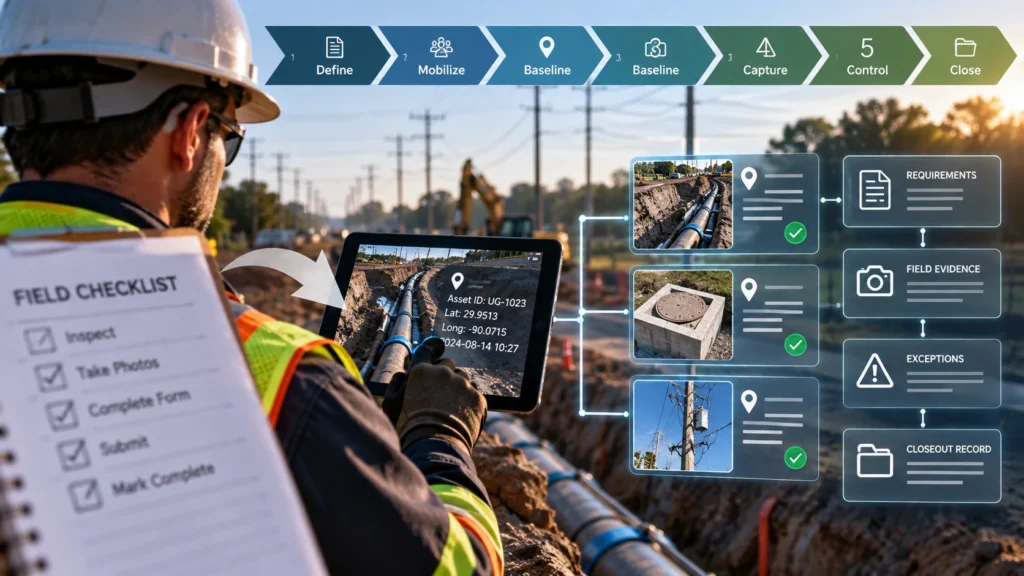
That distinction becomes increasingly important as infrastructure programs become more distributed, documentation-intensive, and dependent on multiple crews, subcontractors, locations, and work packages.
The challenge is not simply to collect more information.
It is to create the right evidence, under a defined standard, with enough context and control that someone else can understand and rely on the record later.
This is where governed field evidence protocols can provide a more structured approach.
Why Checklists Alone Fall Short
Traditional field checklists generally answer questions such as:
- Was the inspection completed?
- Was the required activity performed?
- Were photographs taken?
- Was the form submitted?
- Was the work marked complete?
Those questions have value. But they tend to focus on completion of the process rather than quality and traceability of the resulting evidence.
Consider a simple example.
A field record might contain several photographs labeled with a date and project name. The checklist may show that the required photographs were submitted. Yet months later, an owner or project manager may still have difficulty determining:
- Which asset does each photograph represent?
- Where was the asset located?
- What was its condition before work began?
- What changed during the work?
- Which requirement does the evidence support?
- Was the photograph taken at the appropriate stage of the work?
- Were there unresolved conditions when the work was marked complete?
The checklist has been completed. The evidence chain may still be incomplete.
This is the central shift from a checklist mentality to an evidence-protocol mentality.
What is a Governed Field Evidence Protocol?
A governed field evidence protocol defines what evidence is required, how it should be captured, what information must accompany it, how exceptions are handled, and how the resulting record is controlled through closeout.
The objective is not to burden field teams with unnecessary administration. It is to establish enough structure that field information remains useful after it leaves the field.
A practical protocol typically establishes several elements:
- The requirement — what obligation or outcome needs to be demonstrated.
- The evidence standard — what constitutes acceptable proof.
- The asset or work reference — what the evidence relates to.
- The location — where the activity or condition occurred.
- The timing — when the evidence was captured and at what stage of work.
- The responsible party — who created, reviewed, or acted on the record.
- The exception process — what happens when required information is missing or conditions differ from the plan.
- The closeout relationship — how individual records become part of the final completion package.
This creates a controlled chain from requirement to field activity to evidence to decision to closeout.
Start With the Requirement, Not the Photograph
One of the most important principles is to define the evidence requirement before field work begins.
Instead of asking:
“What photographs should the crew take?”
a stronger question is:
“What must ultimately be demonstrated, and what evidence will prove it?”
That distinction changes how documentation is designed.
For example, a work package may require evidence that an asset was correctly identified, that its initial condition was documented, that specified work was completed, and that the final condition can be verified.
Those requirements can then be translated into an evidence map.
| Requirement | Evidence | Required Context | Exception Trigger |
|---|---|---|---|
| Asset identification | Asset record/photo | Asset ID, location | Asset cannot be uniquely identified |
| Baseline condition | Pre-work documentation | Date, location, condition | Baseline unavailable or incomplete |
| Work progress | Progress evidence | Work stage, asset reference | Work differs from planned sequence |
| Completion | Completion documentation | Final condition, date, location | Completion evidence insufficient |
| Outstanding issue | Exception record | Owner, impact, due date | Required condition remains unresolved |
The exact fields will vary by project. The principle remains the same: define the proof standard before asking the field to produce the proof.
Six Building Blocks of a Governed Evidence Process
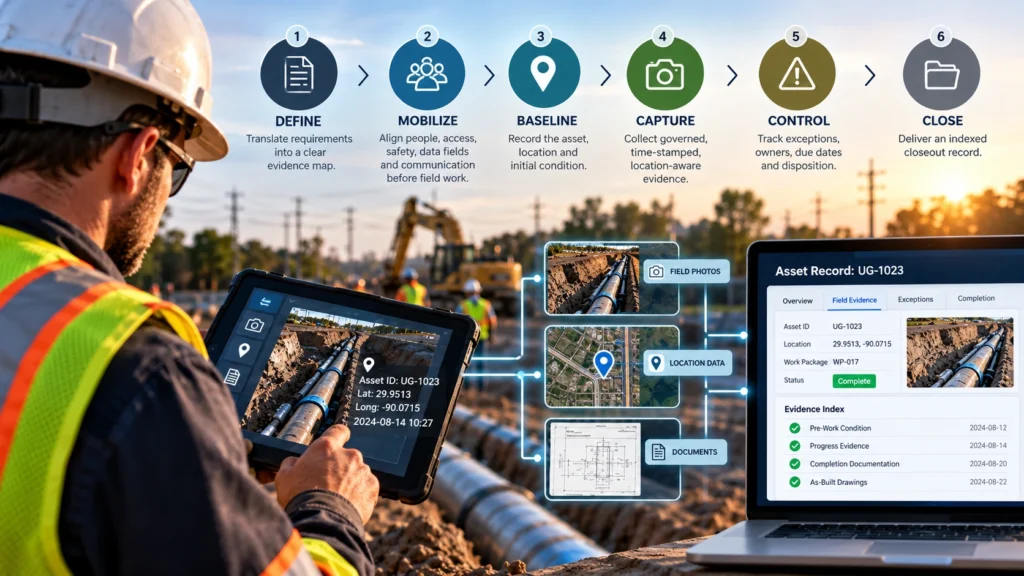
A useful field evidence protocol can be organized around six connected stages.
1. Define
Translate the contract, scope, specifications, reporting requirements, and project expectations into a clear requirement-to-evidence map.
This is where ambiguity should be reduced.
The field team should understand not only what work is expected, but also what must be demonstrated about that work.
2. Mobilize
Before field execution begins, align the people and systems responsible for producing the record.
That can include:
- Access requirements
- Safety requirements
- Roles and responsibilities
- Reporting cadence
- Required data fields
- Communication procedures
- Escalation paths
- Documentation expectations
A protocol is only useful if the people operating it understand it before work starts.
3. Baseline
Establish the starting point.
For distributed infrastructure, this can mean recording the asset identity, location, initial condition, and required documentation before work changes the site or asset.
Baseline information creates an important reference point for subsequent progress and completion evidence.
Without it, later documentation can show what exists—but not necessarily what changed.
4. Capture
Evidence should be collected in a consistent and controlled manner as work advances.
Useful characteristics can include:
- Time-stamped records
- Location-aware information
- Standardized asset fields
- Consistent photo or video requirements
- Defined naming conventions
- Required contextual information
- Quality checks before records are accepted
The goal is not maximum documentation.
It is usable documentation.
5. Control
No field program proceeds exactly as planned.
Access can change. Existing conditions can differ from assumptions. Materials can be delayed. Work can remain incomplete. Documentation can be missing.
A mature evidence process treats these as controlled exceptions rather than allowing them to disappear into email threads, spreadsheets, or memory.
An exception record can identify:
- The issue
- The affected asset or work package
- The owner
- The potential impact
- The decision required
- The due date
- The eventual disposition
This gives project leadership visibility while corrective action is still possible.
6. Close
The final objective is not simply to have a folder full of photographs and forms.
It is to produce an indexed record of completion evidence, unresolved items, and final handoff status.
A good closeout record should allow a reviewer to move logically from the requirement to the relevant field evidence without reconstructing the entire project history.
Evidence Quality Matters as Much as Evidence Quantity
More documentation does not automatically create better documentation.
A program can accumulate thousands of photographs and still have an inadequate evidence record.
Evidence quality depends on context.
A useful field record should answer questions such as:
What is this?
The asset, work order, location, or work package should be identifiable.
Where is it?
The record should provide enough location context to establish where the activity occurred.
When was it captured?
Timing can be important for establishing sequence and demonstrating conditions at a particular stage.
What does it demonstrate?
The relationship between the evidence and the requirement should be clear.
What happened next?
If the evidence identifies an issue, the record should connect to its disposition or required decision.
These questions turn documentation from a collection of files into a traceable record.
Design for the Person Who Will Review It Later
Field documentation is often created by one person and reviewed by another.
Sometimes the reviewer will not see the site until weeks or months later. In other cases, the original field personnel may no longer be involved when a question arises.
That means evidence protocols should be designed for future interpretation, not just immediate submission.
A field record should make sense to someone who was not standing beside the asset when the photograph was taken.
This is one reason standardized fields, location information, timestamps, asset identifiers, and evidence indexes can be valuable. They reduce the amount of institutional memory required to interpret the record.
Connect Exceptions to Decisions
One of the biggest weaknesses in conventional documentation systems is the separation between field observations and management decisions.
A field team may identify a problem. A project manager may discuss it by email. A contractor may subsequently make a correction. But if those events are not connected, the final record can contain gaps.
A governed protocol creates a path such as:
Observation → Exception → Owner → Decision → Corrective Action → Verification → Closeout
This does not mean every field observation requires a formal escalation.
It means that material exceptions should have a defined route to resolution.
The result is a more visible relationship between what happened in the field and what was ultimately accepted or left unresolved.
Build the Protocol Into the Workflow
A common mistake is to create an evidence standard as a separate document and then expect field personnel to remember it.
A better approach is to integrate the protocol into the actual workflow.
For example:
Before mobilization
Define the evidence requirements and responsibilities.
At baseline
Confirm the asset, location, initial condition, and required evidence set.
During execution
Capture governed progress evidence and perform quality checks.
When an exception occurs
Record the issue, assign ownership, identify the required decision, and track disposition.
At completion
Confirm that required evidence exists and that outstanding items are identified.
At closeout
Index the evidence and connect it to the relevant work package, asset, and completion status.
The protocol therefore becomes part of how the work is performed—not an administrative exercise performed afterward.
Technology Helps, but Governance Comes First
Digital tools can make field evidence easier to capture, organize, search, and review.
Location-aware records, standardized forms, mobile applications, controlled photo capture, geospatial indexes, dashboards, and document repositories can all contribute to a stronger evidence process.
But technology does not determine what constitutes acceptable evidence.
A sophisticated platform can still produce a poor record if:
- Requirements were never clearly defined.
- Field roles were ambiguous.
- Evidence standards were inconsistent.
- Exceptions were not controlled.
- Data fields were incomplete.
- Closeout requirements were established too late.
The sequence matters:
Define the requirement → establish the evidence standard → design the workflow → then select and configure the technology.
Technology should support the operating model rather than substitute for it.
A Practical Test: Can Someone Defend the Record?
A useful way to evaluate an evidence protocol is to imagine a reviewer who was not involved in the project.
Give that person the final record and ask:
- Can they identify what work was required?
- Can they identify the assets or locations involved?
- Can they establish the starting condition?
- Can they see what happened during execution?
- Can they identify exceptions and their disposition?
- Can they determine what supports completion?
- Can they distinguish completed work from unresolved items?
- Can they trace the evidence back to the underlying requirement?
If the answer to several of these questions is “not without additional explanation,” the documentation process may still depend too heavily on institutional memory.
That is a sign that the evidence protocol can be strengthened.
The Goal is Not More Paperwork
Governed field evidence should not be confused with bureaucracy.
The purpose is to make field execution more visible while reducing the amount of reconstruction required later.
A well-designed protocol can actually simplify work by giving field teams a clear answer to a basic question:
What do I need to capture so the next person can understand and verify what happened here?
For project managers, the benefit is a clearer view of status and exceptions.
For contractors and subcontractors, it provides a consistent basis for documenting performance.
For owners, it can create a more traceable connection between requirements, field execution, and completion.
And for long-lived infrastructure programs, it creates a record that remains useful after the original project team has moved on.
From Checklist Completion to Proof
Checklists remain valuable. They provide structure, establish accountability, and help teams remember required activities.
But complex infrastructure programs increasingly need something beyond confirmation that a task occurred.
They need a controlled chain of evidence.
That means defining the proof standard before execution, establishing the baseline, capturing evidence with appropriate context, controlling exceptions as they arise, and organizing the resulting records for closeout.
The broader principle is straightforward:
Do not wait until closeout to discover what evidence was missing. Define the proof standard before the work begins.
When requirements and evidence are connected from the start, field documentation becomes more than a compliance exercise. It becomes part of the project’s operating system—helping teams see what happened, identify what remains unresolved, and leave behind a record that others can understand and defend.