Utility programs are often measured by visible outcomes: miles of infrastructure improved, assets hardened, work orders completed, or communities served.
But behind every completed field activity is another requirement that can determine whether a program closes cleanly and stays within budget: the quality and completeness of the field record.
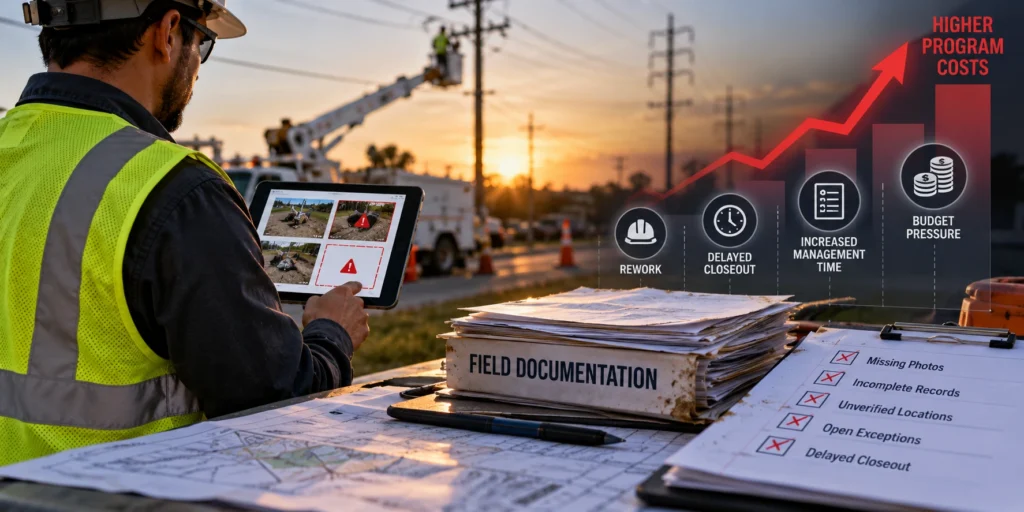
When field documentation is incomplete, inconsistent, delayed, or difficult to connect to the asset and work performed, the consequences can extend well beyond paperwork. Program teams may spend additional time validating completed work, resolving discrepancies, recovering missing evidence, processing exceptions, and reconstructing the project record.
Over a large or distributed utility program, those small inefficiencies can become meaningful budget pressure.
Field Documentation is Part of Program Control
Field documentation is often treated as a reporting requirement. In practice, it can serve as part of the control system for a utility program.
A useful field record should help answer basic questions:
- What asset or work location was involved?
- What was the condition before work began?
- What work was performed?
- When and where did it occur?
- What evidence supports completion?
- Were there exceptions or unresolved conditions?
- Who is responsible for the next action?
- What documentation is required for final closeout?
ANI’s operating approach is built around connecting contractual requirements to field execution and maintaining a controlled chain of evidence through completion.
When those connections are missing, program leaders may have to spend time reconstructing the field story after the work has already occurred.
That is where documentation gaps can become budget issues.
Where Incomplete Documentation Creates Cost Pressure
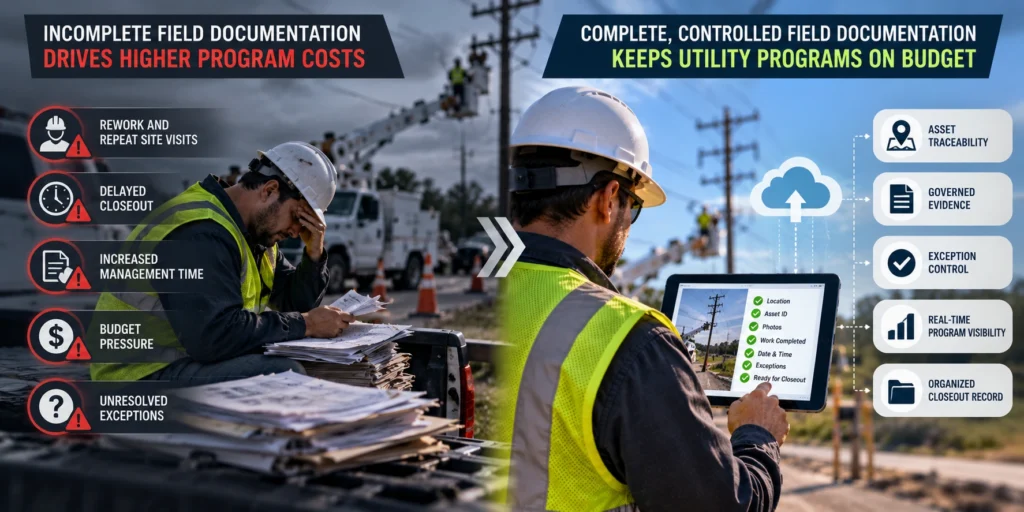
1. Rework and Repeat Site Visits
One of the most direct impacts of incomplete documentation is the need to revisit work that may already have been performed.
For example, if a completion record does not clearly establish the asset location, condition, date, or required evidence, a project team may not be able to confidently verify the work from the original record.
A repeat site visit may then be necessary.
The cost is not limited to field labor. It can involve:
- Crew or inspector time
- Travel and mobilization
- Access coordination
- Traffic or site controls
- Equipment availability
- Administrative processing
- Schedule disruption
The underlying work may have been completed correctly, but insufficient evidence can make verification more expensive than it needed to be.
2. Delayed Closeout
Incomplete records can also slow the transition from field execution to final closeout.
Instead of moving directly from completed work to an organized handoff, teams may have to identify missing records, contact field personnel, reconcile conflicting information, and determine whether an item is actually complete.
ANI’s Scope-to-Proof™ method explicitly includes a final closeout step: delivering an indexed record of completion evidence, unresolved items, and final handoff status.
The objective is straightforward: do not wait until closeout to discover that the evidence needed for closeout is missing.
3. Exception Management Becomes More Expensive
Not every documentation gap means the underlying work is wrong.
But every unresolved gap creates uncertainty.
Without a structured way to identify the issue, assign an owner, establish an impact, set a due date, and record the disposition, small documentation problems can remain open longer than necessary.
ANI’s field-control framework treats exceptions as something to be surfaced and managed during execution rather than discovered at the end.
Early visibility matters because corrective action is generally easier when the relevant people, information, and field conditions are still accessible.
4. Management Time Gets Redirected to Reconstruction
Incomplete field documentation does not only affect field teams.
Program managers, project controls personnel, contractors, owners, and executives may all become involved when the project record does not clearly show what happened.
Instead of reviewing a decision-ready status record, management may have to answer questions such as:
Was this asset actually completed?
Which location does this photograph correspond to?
Was the condition documented before work began?
Is this an open exception or simply a missing record?
Who is responsible for resolving it?
The more time required to reconstruct those answers, the less time the program team has available for managing production, schedule, risk, and decisions.
Distributed Utility Programs Increase the Challenge
Documentation becomes particularly important when work is spread across multiple locations, crews, subcontractors, or work packages.
A distributed program can generate large volumes of field information. Without consistent requirements and data structures, documentation quality can vary from one crew or location to another.
That creates a familiar problem: the program may have plenty of information, but not enough controlled evidence.
ANI’s approach addresses this by establishing documentation requirements before field execution, including asset and location information, required evidence, reporting expectations, and escalation procedures.
The goal is consistency.
A photo, inspection record, work-order update, or completion record becomes more useful when it can be reliably connected to the corresponding asset, location, requirement, and status.
The Budget Impact Is Often Indirect
The financial effect of incomplete documentation is not always visible as a single line item labeled “documentation cost.”
Instead, it can appear across several categories:
Field labor: additional verification, inspection, or documentation activities.
Travel and mobilization: return visits to locations where evidence is incomplete.
Project controls: additional effort to reconcile status and requirements.
Schedule: delays caused by unresolved documentation or completion questions.
Closeout: additional effort to assemble, index, and validate final records.
Management: time spent resolving issues that could have been identified earlier.
Risk: increased uncertainty around whether work can be demonstrated as complete.
This is why field documentation should be viewed as part of program execution—not simply as an administrative deliverable.
A Better Approach: Define the Evidence Before the Work Starts
The most effective time to decide what evidence is required is before crews begin field execution.
A practical documentation framework can establish:
- The asset or work package
Define what is being documented and how it will be identified. - The baseline condition
Establish the starting condition before work occurs. - Required evidence
Specify the photographs, records, measurements, forms, locations, or other documentation needed. - Timing and ownership
Make clear when documentation must be captured and who is responsible. - Exception requirements
Define how missing information, field constraints, and deviations are recorded and escalated. - Closeout requirements
Establish what constitutes a complete evidence package before work is considered ready for handoff.
ANI describes this as a requirement-to-evidence approach: translating scope, specifications, and reporting obligations into a clear evidence map before field execution.
That shift—from “collect documentation” to “define the proof standard”—can make field information much more useful to program teams.
What Program Leaders Should Look For
Utility program leaders can ask several practical questions before a distributed field program begins:
Can every field record be tied to the correct asset or location?
If not, verification and reconciliation may become difficult later.
Is the required evidence defined before mobilization?
If every crew interprets documentation requirements differently, consistency becomes harder to maintain.
Are missing records visible while work is still underway?
A missing photograph discovered months later is a different problem from one identified while the crew is still in the field.
Are exceptions assigned and tracked?
An exception without an owner, due date, or disposition can remain unresolved indefinitely.
Can the final record be handed over without reconstructing the project history?
A strong closeout package should make the completion story easier to understand, not require another investigation.
From Field Activity to Defensible Record
The objective is not to create documentation for documentation’s sake.
The objective is to create a reliable connection between what was required, what happened in the field, what remains unresolved, and what supports completion.
ANI’s Scope-to-Proof™ method organizes that process into six control points:
Define → Mobilize → Baseline → Capture → Control → Close
This framework is designed to establish requirements before execution, capture governed evidence as work advances, manage exceptions while corrective action remains possible, and finish with an indexed closeout record.
For utility owners and prime contractors, that can provide a clearer basis for understanding field progress and completion without relying on fragmented records or after-the-fact reconstruction.
The Takeaway
Incomplete field documentation may look like a small operational issue when viewed one work order at a time.
Across a large utility program, however, repeated documentation gaps can contribute to additional field activity, delayed closeout, increased project-controls effort, and management time spent resolving uncertainty.
The practical response is to treat evidence as part of the work itself.
Define what must be proven. Establish who is responsible. Capture the evidence while the work is happening. Surface exceptions early. And organize the final record so that completion can be understood and defended.
That is the foundation of disciplined utility program execution.
Define the work. Establish the proof standard.
At ANI LLC, utility assurance is built around field evidence, asset-level traceability, exception control, project controls, and closeout discipline.
If your utility or infrastructure program is dealing with distributed field work, documentation recovery, verification, or closeout challenges, ANI can help establish a defined evidence standard and a controlled path from field execution to final record.