Sewer and stormwater infrastructure projects rarely fail because of one obvious problem. More often, risk accumulates across hundreds or thousands of individual assets, work locations, crews, inspections, records, and decisions.
A rehabilitation program may span multiple neighborhoods. A stormwater improvement program may involve distributed drainage assets, underground structures, roadway interfaces, and civil work performed by multiple crews or subcontractors. As the geographic footprint grows, so does the challenge of knowing what was required, what happened in the field, what remains unresolved, and whether the final record adequately supports completion.
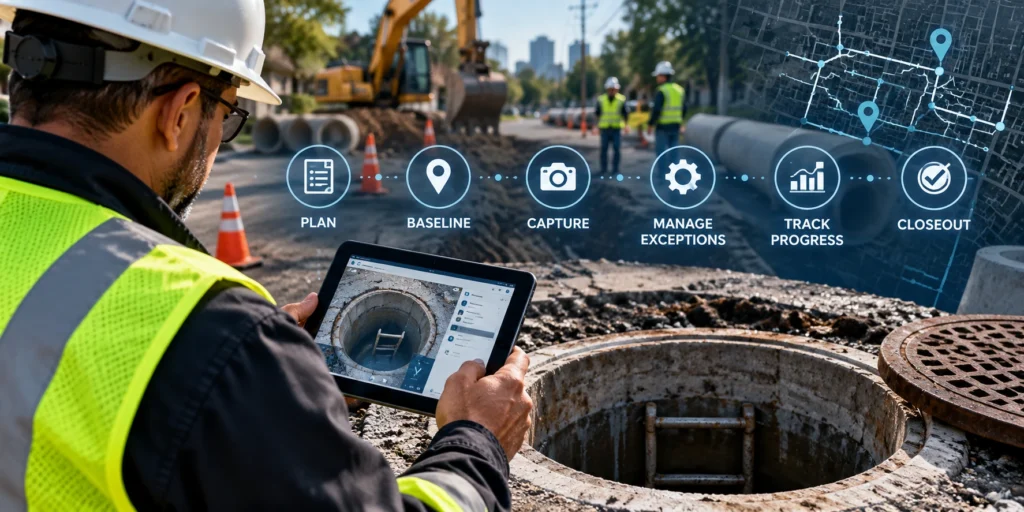
For owners, utilities, prime contractors, and program managers, the challenge is therefore not simply getting the physical work completed.
It is maintaining visibility and control from scope through closeout.
That is where disciplined field assurance and project controls can materially reduce risk.
Why Distributed Infrastructure Creates Unique Risk
Distributed sewer and stormwater programs have a different risk profile from a single-site construction project.
Work is spread across multiple locations, often with different existing conditions, access constraints, crews, schedules, and documentation requirements. Conditions can change between planning and field execution, while information generated by one crew may need to be reconciled with records from another.
Several recurring risks deserve particular attention.
1. Incomplete or inconsistent baseline information
Before work begins, teams need to know what asset they are working on, where it is located, its initial condition, and what evidence is required.
Without a reliable baseline, it becomes harder to distinguish pre-existing conditions from construction impacts, verify that the correct asset was addressed, or establish whether the completed work satisfies the intended scope.
For distributed programs, a baseline should be more than a spreadsheet of asset IDs. It should connect the asset, location, initial condition, work requirement, and expected evidence.
2. Documentation gaps during field execution
Field documentation is often created by multiple people using different processes.
Photographs may lack consistent naming or location information. Progress records may not correspond cleanly to work orders. Inspection information may arrive separately from production information. A missing photograph or incomplete record may seem minor during execution but become significant when someone later needs to establish what actually occurred.
The objective should be to create governed, time-stamped, location-aware evidence while work advances, rather than attempting to reconstruct the project history at the end.
3. Exceptions discovered too late
Every infrastructure program encounters exceptions.
An access problem, unexpected site condition, incomplete information, material issue, schedule conflict, or documentation gap may require a decision. The risk increases when those exceptions remain informal or are discovered only during final review.
A controlled exception process should identify:
- What happened
- Which asset or work package is affected
- Who owns the issue
- What decision is required
- What impact it may have
- When the decision is needed
- How the issue was ultimately resolved
The earlier an exception becomes visible, the more options the project team generally has to address it.
4. Fragmented responsibility
Distributed programs frequently involve owners, prime contractors, subcontractors, inspectors, field personnel, engineers, and other stakeholders.
If responsibilities are not clearly defined, critical activities can fall between organizational boundaries. One party may assume another party is responsible for documentation, verification, escalation, or closeout.
A responsibility and authority matrix can establish who is accountable for each requirement and who has authority to make or approve relevant decisions.
5. Closeout becomes a reconstruction exercise
One of the most expensive documentation problems occurs when closeout begins and the project team discovers that the evidence needed to demonstrate completion is scattered across emails, shared drives, photographs, spreadsheets, inspection records, and individual devices.
At that point, the organization may have to reconstruct the field story after the fact.
A better approach is to design the evidence record at the beginning of the project and maintain it throughout execution.
Risk Mitigation Starts Before Field Work
Effective risk management begins during mobilization—not after problems appear.
Before crews enter the field, the project team should establish a common operating framework covering:
- Scope and specifications
- Asset and location identification
- Required evidence
- Roles and responsibilities
- Access and safety requirements
- Reporting cadence
- Data fields and naming conventions
- Escalation procedures
- Exception management
- Completion and closeout requirements
This creates a direct connection between contractual or program requirements and what field personnel are expected to document.
The result is a requirement-to-evidence map: a practical reference showing what must be demonstrated and what record will provide that proof.
Establish a Reliable Asset-Level Baseline
For sewer and stormwater programs, asset-level traceability is particularly important.
Depending on the project, the baseline may include:
- Asset identification
- Geographic location
- Existing condition
- Work-order or work-package information
- Pre-work photographs
- Relevant drawings or records
- Required inspection information
- Required completion evidence
- Responsible party
The purpose is not to create documentation for its own sake.
The purpose is to give the project team a reliable starting point against which progress and completion can be evaluated.
ANI’s approach to distributed underground infrastructure emphasizes baseline records, location-aware field records, progress verification, exception visibility, and structured closeout.
Make Field Evidence Consistent
A distributed program can generate a large volume of information. The challenge is making that information usable.
A field evidence protocol can define:
- What must be captured
- When it must be captured
- Who captures it
- Required asset and location identifiers
- Photo or video requirements
- Condition documentation
- Quality checks
- Naming and storage conventions
- Escalation requirements for missing evidence
Consistency matters because project leaders should not have to interpret a different documentation process for every crew or location.
Standardized evidence also makes it easier to identify missing information while crews are still mobilized.
Use Geospatial Information to Connect the Field Record
Location is a fundamental part of distributed infrastructure risk.
When documentation is tied to the correct asset and location, project teams can more easily understand where work has occurred, where evidence is missing, and where exceptions are concentrated.
Geospatial documentation can support:
- Location-aware asset records
- Standardized asset fields
- Condition documentation
- Geographic indexes
- Controlled photo and video capture
- Remote inspection support where authorized
The objective is not necessarily to deploy sophisticated technology for its own sake. The objective is to make the relationship between asset, location, work, and evidence clear.
Manage Exceptions as Part of the Work
Exception management should not be treated as an administrative afterthought.
A useful exception record answers five basic questions:
What is the issue?
Clearly describe the condition or missing requirement.
Where is it?
Identify the affected asset, location, work order, or work package.
Who owns it?
Assign responsibility for investigation, decision, or corrective action.
What happens next?
Identify the required decision, action, or information.
How was it resolved?
Record the final disposition and supporting evidence.
This creates a traceable history rather than relying on informal conversations.
ANI’s project-control framework specifically includes exception and decision logs, responsibility tracking, status reporting, and closeout traceability.
Keep Program Leaders Focused on Decisions
Executives and program managers generally do not need every photograph or field note.
They need a reliable understanding of:
- What has been completed
- What is currently in progress
- What is behind schedule
- What exceptions are open
- Which decisions are required
- Where evidence is incomplete
- What risks could affect completion
- Whether the program is ready for closeout
Good project controls turn large volumes of field information into decision-ready information.
This is particularly important when a program includes multiple crews, contractors, locations, or work packages.
Design Closeout at the Beginning
Closeout should not be the point at which the project team starts asking what evidence exists.
The required closeout record should be defined during project setup.
For each asset or work package, the project should be able to answer:
What was required?
What was performed?
What evidence demonstrates completion?
What exceptions occurred?
How were those exceptions resolved?
What remains open?
Who accepted or received the completed record?
This approach changes closeout from a document-recovery exercise into a controlled handoff.
A structured closeout package can include an indexed evidence record, unresolved-item disposition, final status, and other project-specific documentation required by the owner or prime contractor.
A Practical Six-Point Risk-Control Framework
For distributed sewer and stormwater infrastructure programs, risk can be managed through a repeatable sequence:
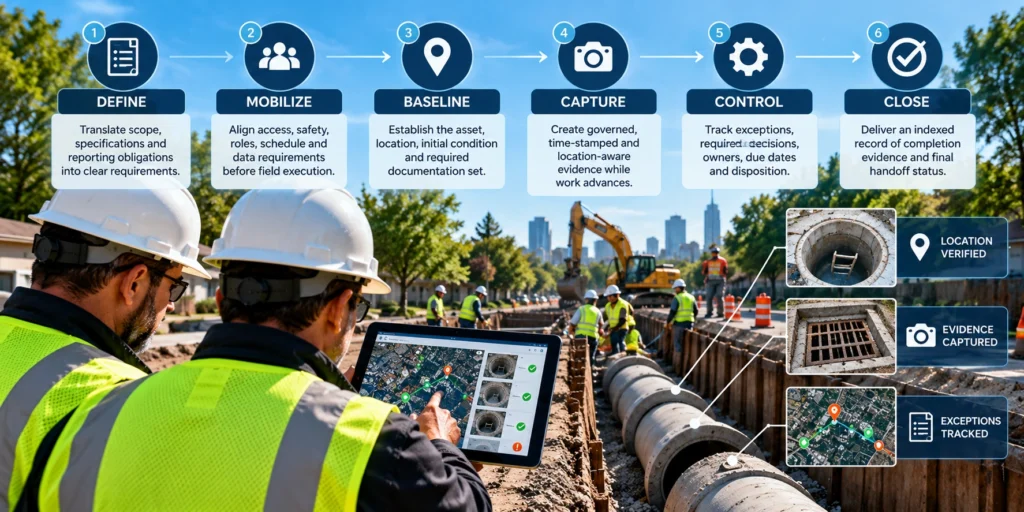
1. Define
Translate scope, specifications, and reporting obligations into clear requirements and evidence expectations.
2. Mobilize
Align access, safety, responsibilities, schedules, communication, data requirements, and escalation procedures before field execution.
3. Baseline
Establish the asset, location, initial condition, and required documentation set.
4. Capture
Create governed, time-stamped, location-aware evidence as work progresses.
5. Control
Track exceptions, missing information, required decisions, owners, due dates, and dispositions.
6. Close
Deliver an indexed record of completion evidence, unresolved items, and final handoff status.
This is the core logic behind ANI’s Scope-to-Proof™ method. The company’s stated operating model connects requirements to field evidence through six control points: Define, Mobilize, Baseline, Capture, Control, and Close.
What This Means for Infrastructure Owners and Prime Contractors
For owners, disciplined documentation can provide greater visibility into whether distributed work is progressing as intended and whether completion records are sufficiently organized to support handoff.
For prime contractors, a consistent field-assurance process can create a clearer basis for subcontractor coordination, progress reporting, performance tracking, and closeout.
For both, the underlying objective is the same:
Make the work visible. Make the record defensible. Make closeout easier.
That principle is especially relevant to distributed sewer, stormwater, water, and other underground infrastructure programs where the physical work may be spread across a large geography and performed by multiple parties.
The Value of Proof is Greatest When It is Built Into the Work
Risk mitigation does not require creating an enormous administrative layer around construction.
It requires making the right information visible at the right time.
A strong field-assurance program connects requirements to assets, assets to locations, locations to evidence, evidence to exceptions, and exceptions to decisions. By maintaining that chain throughout execution, project teams can reduce the need to reconstruct what happened after the work is finished.
For distributed sewer and stormwater infrastructure, that discipline can be particularly valuable because the program’s complexity is often found not in one large construction site, but in the sheer number of individual assets, locations, work packages, and decisions that must remain connected.
ANI LLC supports distributed underground infrastructure and water/wastewater programs through field evidence planning, asset and location verification, project controls, geospatial documentation, exception management, and structured closeout. Its broader operating principle is straightforward: define the work and establish the proof standard before execution begins.
When infrastructure programs leave behind not only completed assets but also a clear, traceable record of what was required, what occurred, and what remains unresolved, owners and communities are better positioned for the long-term stewardship of those assets.